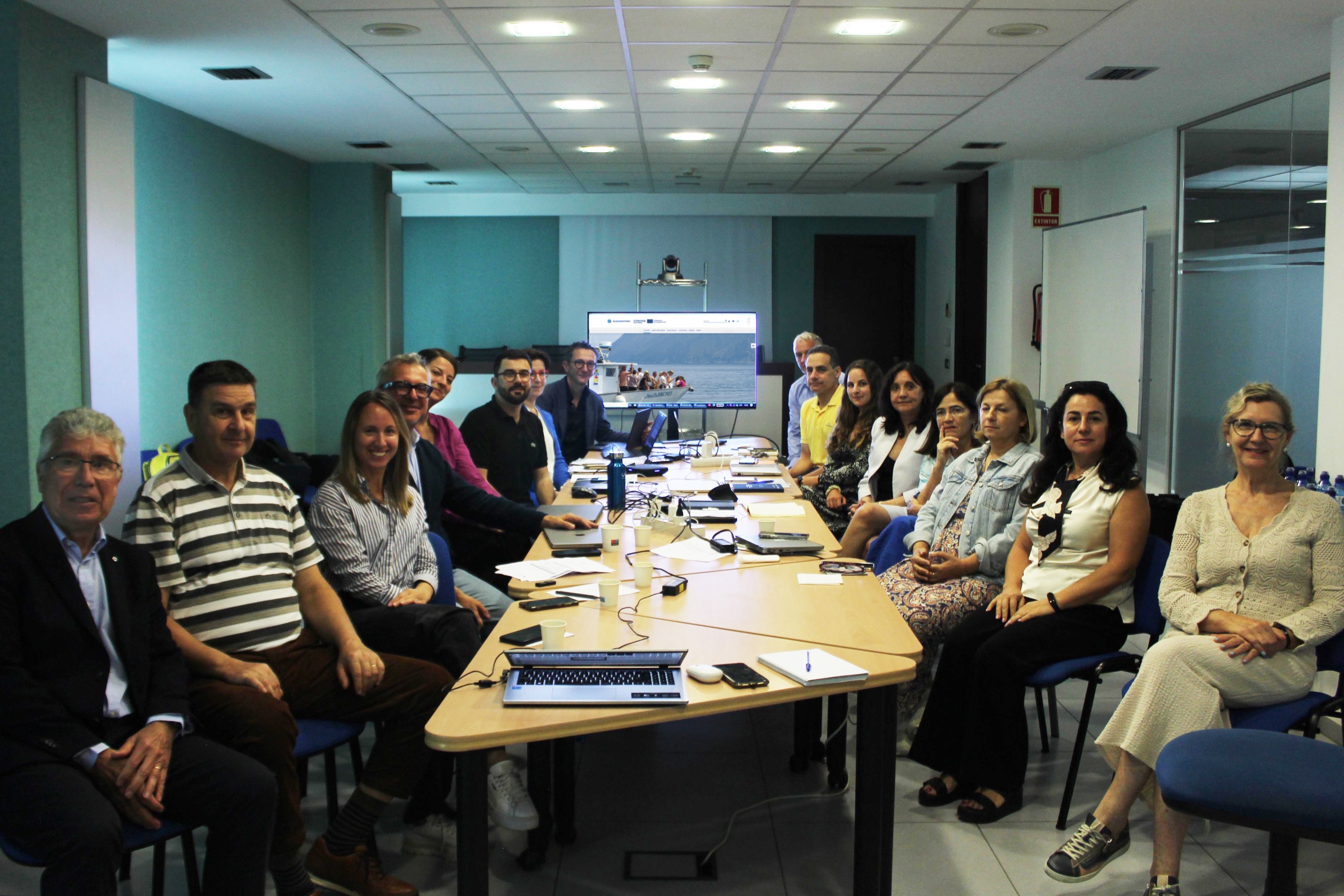

This week we move to Emilia-Romagna, the region that received the highest number of innovative solutions in the BLUE ECOSYSTEM project: an impressive total of 37 proposals. Let’s take a look at how the regional process was.
STEP 1: Identification of regional challenges
Stakeholders from research, industry, public authorities, civil society, and the natural environment participated in co-creation workshops held in March, June, and November 2024. This collective process ensured that the identified challenges reflect real territorial needs and align with the regional S3 strategy.
1. Blue Bioeconomy:
Strengthening data collection and knowledge sharing; research on resilient species and alien species management; promoting sustainable and circular fisheries and aquaculture; decarbonisation of the supply chain; valorisation of waste; reducing anthropogenic pollution and improving water quality.
2. Marine Manufacturing:
Increasing renewable energy production from the sea; supporting the decarbonisation of oil & gas activities; improving sustainability in shipbuilding and boating; promoting material circularity; mitigating environmental impacts of marine activities.
3. Coast & Tourism 2.0:
Climate change adaptation and coastal regeneration; upgrading coastal and tourism-related infrastructure; developing new models for maritime and coastal tourism 2.0; strengthening early warning, forecasting, and monitoring systems.
STEP 2: CALL FOR INNOVATIVE SOLUTIONS
A total of 37 solutions were received during the regional call for transformative solutions, showing strong engagement from Emilia-Romagna’s innovation ecosystem.
Of these 37, 1 was submitted by a regional public authority, 8 by enterprises and SMEs, 1 by a local public authority, 10 by higher education and research organizations, 1 by an education/training centre or school, 1 by a sectoral agency, and 4 by business support organisations.
Distribution across challenges:
• Blue Bioeconomy: 20 solutions
• Marine Manufacturing: 8 solutions
• Coast & Tourism 2.0: 9 solutions
STEP 3: ACCELERATING THE IDEAS THROUGH THE TRAIN LAB
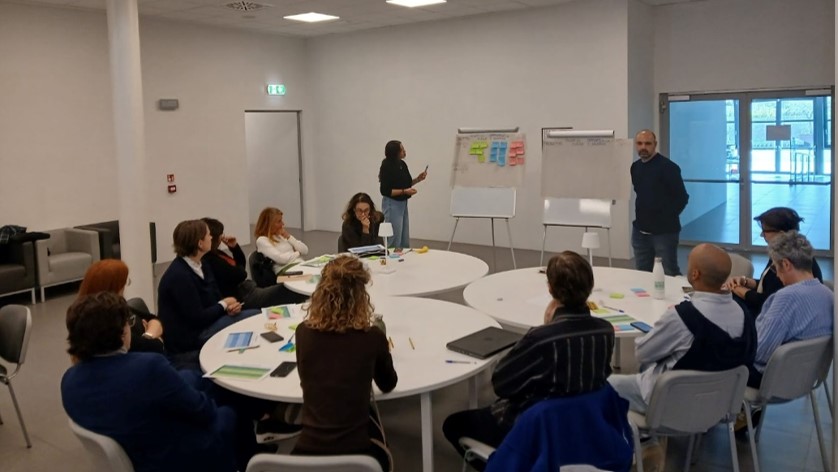
In October 2025, the region launched a structured acceleration path composed of thematic focus groups, co-creation meetings, networking sessions, and technical/strategic discussions with experts. Three sessions were organised — one per challenge.
SESSION 1 |TRAIN LAB — Marine Manufacturing (8 October 2025)
Venue: Tecnopolo di Bologna
Participants: 20
Format: Design sprint methodology with thematic tables
Projects presented included:
• Sea Foot Print – SEA THE CHANGE SRL
• Reconversion of Oil & Gas Platforms – AGNES HOLDING SRL
• Offshore Testing Hub for Energy and Research – CLUST-ER GREEN TECH
• Compressed Air Energy Storage – FSC TECH
• Synthetic fuels from local waste / green CO₂ & H₂ – LEAP S.C.A.R.L.
• SHOREWINNER – IFOA
Key insights & outputs:
• The Offshore Testing Hub was recognised as a strategic regional infrastructure for experimentation
• Strong synergies emerged between R&D initiatives and industrial actors
• Cross-cutting need for training and capacity-building across industry, research, and institutions
SESSION 2 | TRAIN LAB — Coast & Tourism 2.0 (15 October 2025)
Venue: Emilia-Romagna Region – Room C
Participants: 25
Format: Thematic tables per challenge
Table C1 – Coastal regeneration & climate resilience
Challenges: integrated environmental monitoring, data sharing, climate alerts, sustainable infrastructures, citizen science, and training
Outputs: shared coastal data ecosystem; collaboration between UNIBO-NBS, Metaprojects, ARPAE, DCC-CR, ENEA
Table F2 – Forum 2.0
Challenges: enhancing coastal resources, circular economy for tourism, territorial governance models
Outputs: operational network linking research, innovation, and sustainable tourism; joint circular economy initiatives with ENEA, Cluster Build, Agnes and others.
SESSION 3 | TRAIN LAB — Blue Bioeconomy (29 October 2025)
Venue: Fondazione Opificio Golinelli, Bologna
Participants: 20
Projects presented included:
• Coastal Algaeculture – AlgaUlisse, ITACA SOC.COOP.
• Valorisation of algae/fishery waste – CRPA
• Sustainable aquaculture activities – AGNES SRL
• Oyster Ethics – University of Ferrara
• ALGAEBLU – University of Ferrara
• Mapping the Atlantic blue crab – University of Ferrara
• BLUE IS THE NEW GREEN – University of Ferrara
• Valorisation of mollusc shells – ENEA
• Regional processing system for fishery products/by-products – University of Bologna
Key insights & outputs:
• Valorisation of marine biomass & macroalgae for food, biomaterials, and biogas
• Integrated aquaculture, species recovery, environmental monitoring
• Circular approaches for traceability & resilient supply chains
• Strengthened collaboration between universities, research centres, and industry
What will be the selected ideas for the ECOMATCH event on 28 and 29 April 2026?
Stay tuned to BLUE ECOSYSTEM social media for real-time updates (LinkedIn or website).
For further information about the project, please contact jordi.juarez@crpm.org